

The Warning UK Business Owners Cannot Afford to Ignore
If you run a small business, employ staff, or manage your own pension savings as a founder, the government’s proposed pension tax changes could cost you — and your team — significantly more money every year.
Aviva’s chief executive, Dame Amanda Blanc, issued a direct and unusually public warning to Chancellor Rachel Reeves ahead of the Autumn 2025 Budget. Her message was blunt: tamper with salary sacrifice pension relief, and you will push millions of workers closer to an inadequate retirement, whilst simultaneously hiking costs for every employer in the country.
This article breaks down exactly what was proposed, what was confirmed, how it affects your business, and what you can do about it right now — before the window for strategic planning closes.
What Did Aviva’s Chief Executive Actually Say?
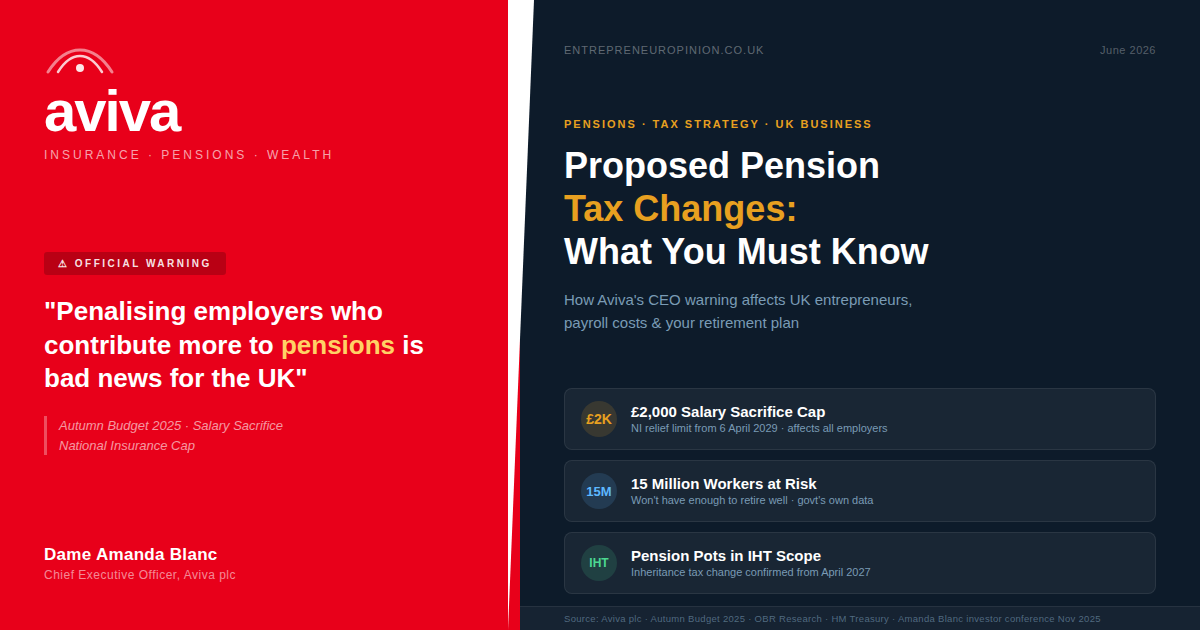
Dame Amanda Blanc, speaking at an Aviva investor relations conference ahead of the 26 November 2025 Budget, did not mince her words. She told attendees that the Treasury’s plan to cap tax-free salary sacrifice contributions was “clearly unhelpful” and warned that the changes would “penalise those employers that actually contribute more to employees’ pensions.”
Her concern was specific. The Treasury was considering capping the National Insurance (NI) relief available on salary sacrifice pension contributions — meaning both employers and employees would begin paying NI on contributions above a certain threshold. At the time, the speculation centred on a cap of just £2,000 per year.
Blanc warned: “If you use the government’s own research, it suggests 15 million people in the UK will not have enough money to retire well.”
She also cited Office for Budget Responsibility (OBR) research suggesting that 40% of people would reconsider how much they salary sacrifice — or stop entirely — if relief were curtailed. That is not a minor behavioural nudge. That is a structural shift in retirement saving behaviour, with generational consequences.
What the 2025 Autumn Budget Actually Confirmed
Despite the warnings from Aviva and a chorus of industry voices, the Chancellor did proceed with a version of the change, though with a longer runway than initially feared.
Here is what was confirmed:
- From 6 April 2029, full National Insurance relief on salary sacrifice pension contributions will be capped at £2,000 per year for both employees and employers.
- Contributions above £2,000 made via salary sacrifice will be subject to both employer and employee NICs at standard rates.
- Ordinary employer pension contributions made directly (not via salary sacrifice) remain fully exempt from NICs.
- The standard pension annual allowance (£60,000) and income tax relief on pension contributions were left unchanged.
- The tax-free cash lump sum allowance remains at £268,275 for 2026/27.
The 2029 implementation date gives businesses roughly three years to restructure their pension arrangements. That sounds comfortable. It is not. Pension scheme changes involve contracts, HR communications, payroll system updates, and benefit negotiations. The planning horizon starts now.
Why This Hits Small Business Owners Hardest
Large corporations have dedicated benefits teams and actuarial advisers who will adapt to this overnight. As a small business owner or startup founder, you are likely doing this yourself — or relying on a single accountant who may not yet be flagging it.
Here is the financial reality.
The Salary Sacrifice Mechanism Explained Simply
Think of salary sacrifice as a three-way tax saving. Your employee agrees to reduce their gross pay by, say, £5,000 a year, and you contribute that £5,000 directly into their pension instead.
- The employee avoids paying income tax and NI on that £5,000.
- You, the employer, avoid paying employer NI (currently 13.8%) on that £5,000.
On a £5,000 sacrifice, your NI savings as an employer are roughly £690 per employee per year. Multiply that across a team of 10, and you are looking at £6,900 annually that currently stays in your business, not HMRC’s coffers.
From 2029, only the first £2,000 of that sacrifice qualifies for full relief. The remaining £3,000 per employee will attract the full NI charge. Your cost per employee goes up. Your ability to offer competitive pension benefits without increasing your wage bill is reduced.
The EV and Cycle-to-Work Knock-On
Blanc also noted that the changes would undermine other salary sacrifice benefits — particularly electric vehicle (EV) schemes. This matters for small businesses trying to attract talent with modern benefit packages. Around 90% of cars ordered through salary sacrifice schemes are electric, driven largely by the favourable 3% benefit-in-kind rate for EVs compared with up to 37% for petrol and diesel vehicles. A cap on NI relief erodes the economic logic of these schemes too.
Is Aviva in Financial Trouble? The Straight Answer
This is a question that surfaces regularly alongside coverage of Aviva’s public policy stances, so let us address it directly.
No, Aviva is not in financial trouble. In fact, the opposite is true.
In its full-year 2025 results, announced in March 2026, Aviva reported:
- Group operating profit up 25% to £2.203 billion, hitting its 2026 profit target a full year early.
- Solvency II own funds generation up 40% to £2.317 billion.
- A 10% dividend increase, its tenth consecutive annual increase.
- A £350 million share buyback was launched alongside the results.
- Over 25 million customers and more than £230 billion in wealth assets.
CEO Amanda Blanc described 2025 as “our fifth consecutive year of strong, profitable growth.” The acquisition of Direct Line Group, completed in July 2025, added over four million new customers and further strengthened Aviva’s position as the UK’s only diversified insurer of scale.
Aviva’s public warnings about pension tax changes are not the pleas of a struggling company protecting its revenues. They are the strategic voice of the UK’s largest workplace pension provider, making a substantive policy argument — one backed by the government’s own data — about the long-term consequences for retirement adequacy in this country.
If anything, Dame Amanda Blanc’s willingness to directly challenge the Chancellor reflects Aviva’s strength, not its fragility.
The Inheritance Tax Bombshell — A Second Front for Entrepreneurs
Salary sacrifice is only one part of the pension tax story. For founders and business owners who have built up significant pension pots as part of their retirement and succession strategy, a second change is arguably more disruptive.
From 6 April 2027, defined contribution pension pots will be brought within the scope of inheritance tax (IHT). This is a fundamental reversal of how pensions have worked for decades.
Currently, the money in your pension pot on death does not form part of your estate for IHT purposes. It passes to your nominated beneficiaries outside of probate, free of inheritance tax. That made pension pots an exceptionally efficient vehicle for wealth transfer — particularly for entrepreneurs who had accumulated significant value in their SIPP or workplace pension.
From April 2027, the death benefit will be included in your estate’s IHT calculation. For deaths from age 75, beneficiaries will also pay income tax on the inherited pension pot.
What This Means Practically
If you are a business owner with a £600,000 pension pot, an £800,000 property, and business assets, your estate could now breach the IHT threshold in a way it previously would not have.
The Aviva guidance published in November 2025 notes clearly: “Many will need to rethink their decumulation strategies as we move towards April 2027. This is a complex and highly individual area of planning.”
Additionally, 100% Business Asset Relief (BAR) — previously an entrepreneur’s key IHT shield on business assets — will be capped at £1 million per person from April 2026. That cap was originally set at £1 million; the £2.5 million increase for agricultural relief announced in December 2025 does not apply to most business owners.
If your business is worth more than £1 million and you were relying on BAR to shelter your estate from IHT, you now have a much more complex succession planning challenge.
Can I Withdraw My Aviva Pension Anytime? Rules You Must Know
Given the tax landscape is shifting, many founders and employees are asking: Can I just take the money out now, before the rules get worse?
Here is the unambiguous answer: you cannot access your Aviva pension before age 55 — and that rises to 57 from April 2028.
This is the Normal Minimum Pension Age (NMPA), set by HMRC, not Aviva. Attempting to access it early outside of very specific exceptions (terminal illness or a Protected Retirement Age, such as for professional sports careers) is not just inadvisable — it is treated by HMRC as an unauthorised payment, carrying a tax charge of up to 55%.
Be wary of any company or advisor claiming they can get you your pension early via “loopholes.” These are pension scams, full stop.
Your Legitimate Access Options from Age 55 (or 57 from 2028)
Once you reach the NMPA, Aviva offers several legitimate access routes for defined contribution pensions:
1. Tax-Free Lump Sum + Drawdown Take up to 25% of your pension tax-free (capped at the lifetime Lump Sum Allowance of £268,275 for 2026/27), then put the rest into income drawdown — keeping it invested while drawing a flexible income.
2. Uncrystallised Fund Pension Lump Sum (UFPLS) Withdraw lump sums directly. Each withdrawal is 25% tax-free and 75% taxable as income.
3. Annuity Purchase Convert your pot, or part of it, into a guaranteed income for life.
4. Leave It Invested. Delay access entirely and let the pot continue to grow. This remains a valid strategy for many founders, though the 2027 IHT changes reduce the attractiveness of large pension pots as pure inheritance vehicles.
One critical warning: the moment you access taxable drawdown income, the Money Purchase Annual Allowance (MPAA) kicks in, limiting future contributions to all money purchase pensions to just £10,000 per year (2026/27 figure). If you are still working, building your business, and plan to continue contributing to your pension, touching drawdown early can severely constrain your future savings.
What Should UK Entrepreneurs and Small Business Owners Do Right Now?
The 2029 salary sacrifice deadline may feel distant. The 2027 IHT pension change is closer than it looks. And the 2026 BAR cap is already live. Here is a structured action plan.
Action 1: Audit Your Current Salary Sacrifice Arrangements
Review your payroll and pension scheme structure now. If you and your employees sacrifice above £2,000 per year into the employer pension, model the post-2029 NI cost increase. Factor it into your staffing budgets. Some businesses will need to renegotiate benefit packages.
Action 2: Maximise Contributions Before the Rules Change
The current NI relief on salary sacrifice above £2,000 remains fully available until 5 April 2029. If you are in a position to increase pension contributions now — for yourself or for your team — the existing tax efficiency is still entirely intact. Use it.
As Aviva’s own advisers note: “Utilising generous allowances and upfront tax relief should be considered annually, especially while full NI relief on salary sacrifice is available.”
Action 3: Revisit Your Succession and IHT Planning
If you have a business worth more than £1 million or a pension pot that could breach IHT thresholds post-2027, speak to a qualified financial adviser about restructuring your decumulation strategy. Options include drawing down the pension earlier (mindful of the MPAA), gifting strategies, or trust arrangements. There is no single right answer — it is entirely dependent on your personal circumstances, your family situation, and your business structure.
Action 4: Don’t Confuse Aviva’s Stability with Government Policy Certainty
Aviva itself is financially robust. It is not going anywhere. But the policy environment around UK pensions is genuinely in flux. Do not assume that because your pension provider is sound, the tax rules governing what you can do with your pot will remain stable. Plan for the changes already confirmed; remain alert to further adjustments.
Action 5: Separate Pension Saving from Business Asset Protection
Many founders conflate their pension with their business succession plan. The post-2027 world makes this significantly more costly. Your SIPP or workplace pension is no longer the clean, IHT-free legacy vehicle it once was. Corporate structures, ISAs, and professional advice on asset distribution now matter more.
Key Takeaways for Founders and Business Owners
To summarise what you now know — and what to do with it:
- Aviva’s CEO was right to ring the alarm. The 2025 Budget confirmed a cap on salary sacrifice NI relief, taking effect in April 2029. It will increase costs for employers and reduce incentives for employees to save.
- Aviva is financially strong. Operating profit is up 25% year-on-year. The warning was about public policy, not corporate survival.
- You cannot access your Aviva pension before age 55 (57 from 2028) without risking a 55% HMRC tax charge. Pension liberation scams are real.
- From April 2027, pension pots will attract inheritance tax. If you have built up a large pension pot as part of your wealth strategy, your estate planning needs an urgent review.
- The BAR cap of £1 million is already live from April 2026. If your business exceeds this in value, standard IHT applies to anything above the threshold.
- Time is your asset. The 2029 deadline gives you runway. Use it to restructure, maximise contributions, and build a tax-efficient retirement plan before the window narrows.
A Final Word
The Aviva CEO’s warning was not alarmism — it was data-backed, policy-grounded, and commercially inconvenient for the government to hear. As a UK entrepreneur, you are already navigating a tighter NI environment, frozen income tax thresholds, and rising operational costs.
Your pension is one of the last great tax shelters available to you. Guard it accordingly.
If you take nothing else from this article, take this: the rules governing your retirement savings are changing on multiple fronts, across multiple timelines. The entrepreneurs who will retire well are the ones who start planning around those changes today — not in 2028.
